Origin 2016 Features

Origin 2016 Features

Origin 2016 Highlights


The table below only lists some highlights of Origin 2016. To see more features in 2016, please use the navigation bar on the left panel of this page.

Origin Interface

JIRA

SUMMARY

DETAILS

JIRA

SUMMARY

DETAILS

ORG-13548

Enable/Disable Collapsible Menus from Tools:Options

User can disable/enable collapsible menus by check box in Miscellaneous tab of Tools:Options.

ORG-10737


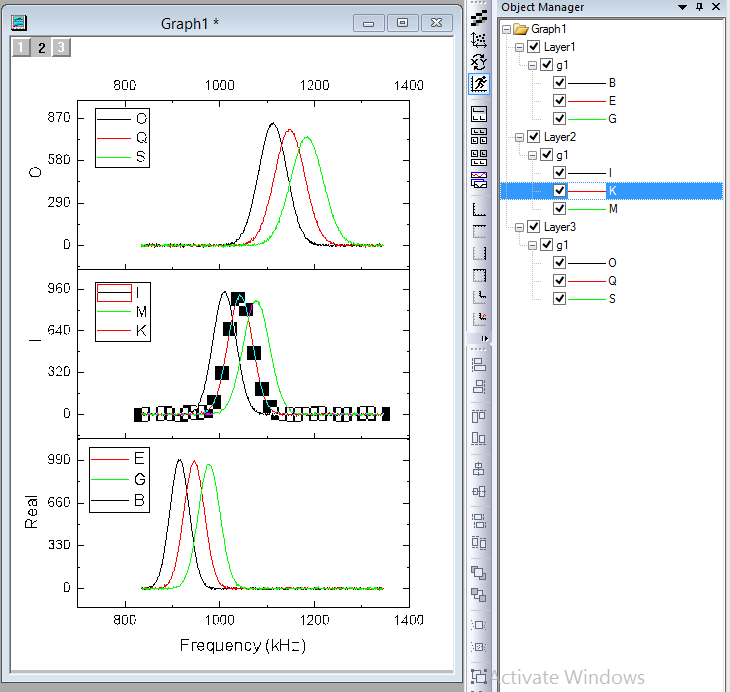
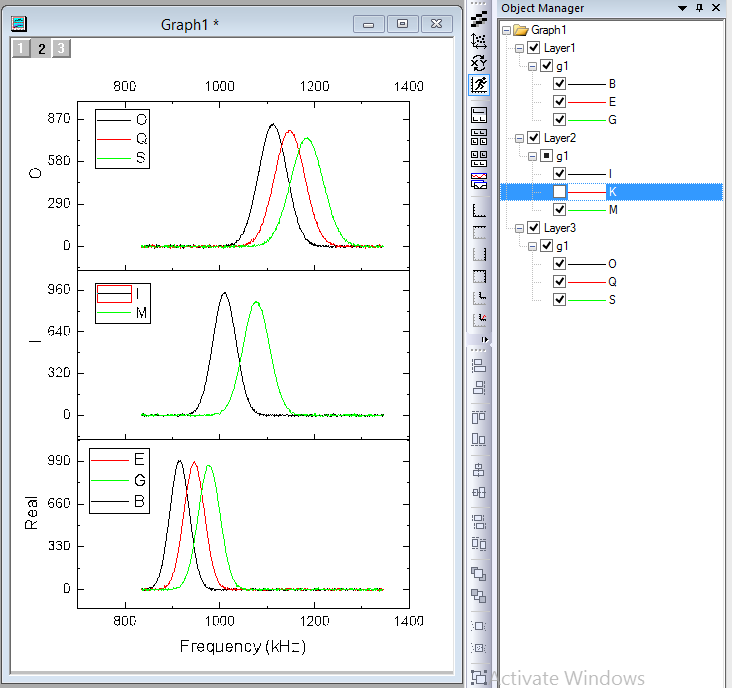
Dockable Object Manager to easily Show or Hide Plots on a Graph

Hide and show plots using Object Manager

  • Select an element item in the Object Manager to select the corresponding element in the graph window and Vice Versa.

  • Show group level for the data plot if there is grouped data.

  • Show/hide plots by checking/unchecking the box before the object name. The object name corresponds to the legend name through translation mode.


Useful context menu tools inside Object Manager

  • Hide/Show a set of plots with the same name.

  • Change the order of plots in the same layer.

  • Change the plot style.

  • Go to Plot detail, Plot Setup, Layer Content from object manager.


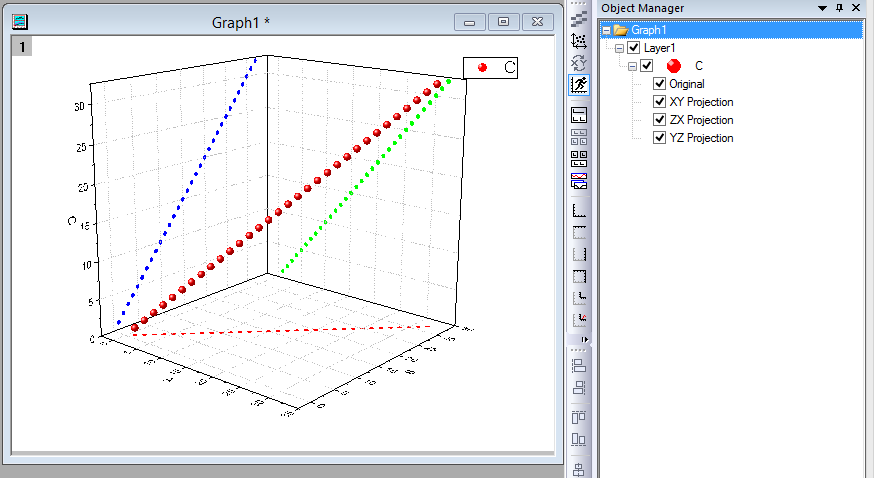
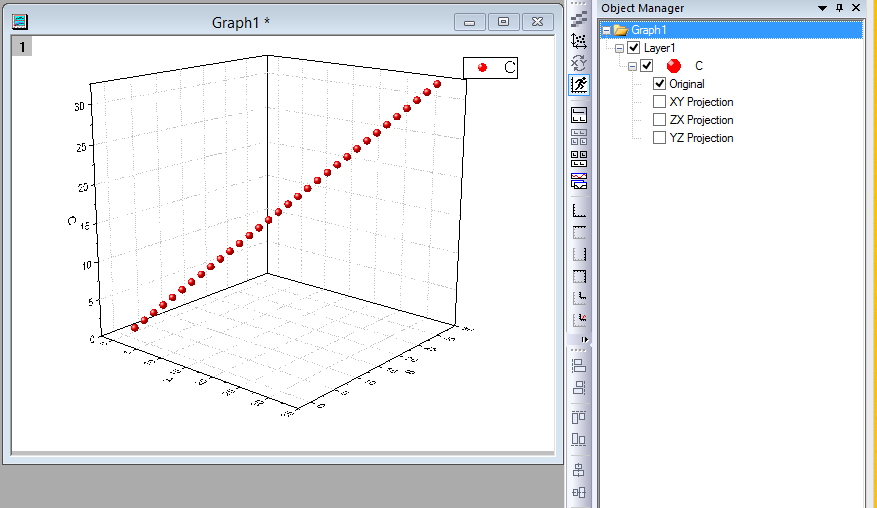
For 3D Scatter plots, XY Projection, ZX Projection, YZ Projection items are included in object manager as well.

ORG-12904

GUI to Rename Plots with Loose Data (2D function plot & virtual matrix)

Set the short name of the 2D function plot

Under the label tab of the Create 2D Function Plot dialog, we can set the Function short name.


Short name or long name of the loose data can be changed in plot detail dialog

Open the plot detail dialog of a 2D function plot or virtual matrix plot, we can change the short name or long name of the plot.

Clicking the small button besides the name will toggle between long name and short name.

ORG-12763

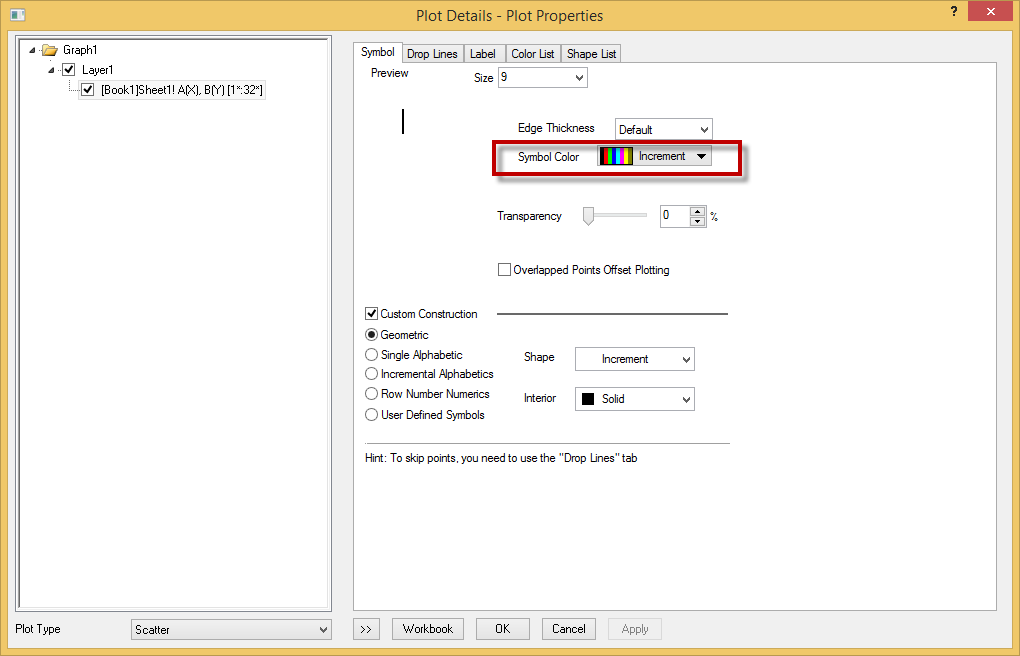
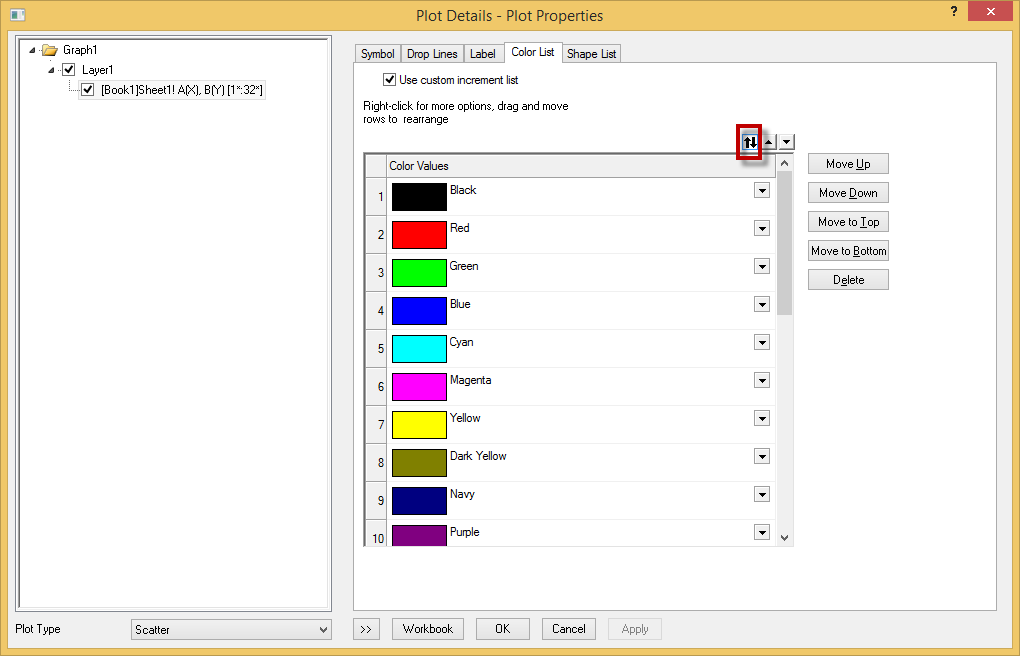
Support flip color increment list

Allow the order of colors in the color list or the order of shapes in the shape list be flipped. 

When the Symbol Color is set to increment, can flip the order in the Color List tab. This also applies to the symbol shape.

ORG-12900,

ORG-12835,

ORG-13450

Use tab style dialog for more analysis and statistics tools

Changed the dialog to be tab-based for the analysis/statistics tools with long trees, especially those statistics tools.

User can change back to old GUI by setting system variable @TSD to 0. (Choose Tools: System Variables... menu. Enter TSD as Variable and enter 0 as Value.)

ORG-11356

Better extra large icon images for folder, workbook, matrix, notes, excel book in Project Explorer  (SR1)

ORG-13960

Flyout buttons on Toolbars more obvious  (SR1)

Before SR1 – Tiny, not obvious

In SR1 – More standard, easier to click on to expand

ORG-13777

Change Color List on By Points tab of Chooser Chooser  (SR1)

Before SR1, user must change color list on Color List tab of Plot Details if the plot color is set to incrementing or using other column values.

In SR1, user can directly change Color List on By Points tab of Color Chooser.

ORG-13917

Ctrl+ click Color List or Increment List in Color Chooser to edit color orders. (SR1)

In SR1, user can click Ctrl+click Color List on By Points tab or Increment List on By Plots tab of Color Chooser to change the order of colors and save as future color increment list.

ORG-14036

Template Library Filter status better not kept between Origin sessions (SR1)

Before SR1, if user pressed Filter down to exclude cloneable templates that don't match the active workbook, when restarting Origin, the filter button is still pressed and no template may show in Template Library since default Origin workbook only has two columns A(X) and B(Y).

In SR1, a system variable @TLF is added in SR1 to allow this filter state to be
0. never remember, always reset to no filter
1. remember between open in same session (default)
2. remember between sessions

ORG-13757 S1

Add Allow System Theme to override checkbox in Template Modify dialog (SR1)

When plotting graph with a user-defined graph template,

system theme will be applied if this Allow System Theme to Override checkbox is checked when saving graph template

User can click edit button in Template Library to uncheck it now in SR1.

ORG-13614

Support Shapefile map in Object Manager (SR1)

After import Shapefile maps into Graph, the shapemap would be showed as a branch in Object Manager, each part could be a sub-object in this branch. So once the selection is turned on(right-click an object and select Selectable to turn on or turn off), users can select and modify the map, the selection of whole and partial could be similar to group and plot.


ORG-14269

Startup Tips Dialog Improvements (SR2)

We improved Startup Tips dialog.

  1. Four new buttons are created to help new users get started, which include Getting Started Tutorials for user to follow step by step, and 3 quick overview videos to watch..

  2. Help: Startup Tips menu is added so user can open the dialog any time.

  3. Open Sample OPJs buttons is removed since user can always open sample opjs from File: Open Sample Projects: menu.

ORG-14353

Color palette is more friendly to people with color-blindness (SR2)

Add two built-in color lists for color-blindness people: Q09 ColorBlindSafe8 and Q10 ColorBlindSafe15


Graphing

New Graph Types

JIRA

SUMMARY

DETAILS

JIRA

SUMMARY

DETAILS

ORG-12500

Support 100% stacked column/bar plot with error bar

Error bar is supported in 100% stacked column/bar plot.

ORG-7860

Support Interval Plot

Add Interval Plot under the Plot:Statistics.  Interval Plot plots the mean and 95% confidence interval for grouped data. 

Labels, Legend, Color Scale and Bubble Scale

JIRA

SUMMARY

DETAILS

JIRA

SUMMARY

DETAILS

ORG-12927,

ORG-13065

Easier Way to Annotate Graph with Data or Label in Worksheet and Project&Window Information

Support inserting variables from worksheet cell into text (only for graph)

Add a button in Insert Variable dialog, which can hunt worksheet cell and then insert it:

  1. The substitution text will be in the form of (n, @WT, col, row).

  2. It supports both label area and data area.


  3. Also support selecting data range.


Additional Info (%G, %X, %H) in Plot level for Insert Variable Dialog

In the Insert Variable Dialog, if the root folder(root node) of the worksheet(graph) on the right panel is selected, we are able to insert: 

1. Active Window Name //%H
2. Project Path //%X, only show when the project was saved once
3. Project Name //%G, only show when the project was saved once

into the graph or worksheet.

Worksheet insert variable dialog:

Graph insert variable dialog:

ORG-6449

Annotation Tool: Customize Display Label, including metadata support, etc.

Allow to customize the format of the annotation added to the plot. It is available for 2D XY plot and polar, and contour from both XYZ data and matrix.

How to...

  1. Select an annotation object, right click and select Customize Label to open the Annotation dialog.

  2. in the Label Form we can specify the quantities or dataset used to create the annotation.

  3. If Custom is selected, Format label is opened up and format string/Labtalk scripts can be entered, and multiple notations and arbitrary fixed strings can be combined as desired. The > button lists the frequently used notations.

  4. Apply to can apply the format to the annotations of the current object, the objects in the current layer or all the objects inside the graph window.

ORG-10446

Data Labeling on Indiced Points Only and More Label Format Controls

Show Legend along Plot by Attaching Data Label on a Single Point or several points

ORG-12227

GUI for leader line in 3D plot label

Add GUI to allow the access to the leader line setting

Color, width, direction, shape of the leader line in 3D plot can be changed.

ORG-11816

ORG-10371

ORG-12357


Legend and Color Scale improvements

Legend text follow legend symbol color. Also works for color scale.

right click legend to enable object property. Setting color to Auto will have the color of the label follow the color of the symbol.

This is also support for regular text label. If there is %(n) substitution notation(s) and color is set to Auto, it will use the 1st substitution notation's corresponding plot's color for the whole text

Also works for color scale label


Show color scale as blocks of colors and their corresponding range

  1. In the Color Scale Control dialog, we can change the display format of the labels from just showing a value to showing a range. (see the result)

2. Allow color bar to be separated.

3. the result:


Notation to Alignment different portions of text in multiple line

add "\^()" as cell anchor, use alignment from the whole text object "\^(l)", "\^(c)", "\^(r)" are LEFT,

CENTER and RIGHT alignment respectively.

"^(lu)" means the text before and after this anchor is a unit, the part before and the part after will not be added extra space by drag and control. But the part before and after "^(lu)" will still consider the alignment separately, like it contain 2nd level.


ORG-13167

Control Legend border line width on Style toolbar (SR1)

ORG-13830

Fill Pattern supported in Categorical Legend (SR1)

Fill Pattern checkbox is added in Categorial legend dialog

ORG-14327

Data label not shown at last point because for missing values (SR2)

Last point in data label should be the last plotted regardless the rest of missing values.

Plot Manipulation

JIRA

SUMMARY

DETAILS

JIRA

SUMMARY

DETAILS

ORG-373

New, Powerful Color Chooser: Larger Color Collection, Easier Way to Pick Custom Colors, and Recent Colors

New Color chooser for all elements in Origin that supports color customizatin, such as plots, axis, text labels, graphic object, cells in worksheet, etc.

  • Set color as Single, By Points or By Plots

  • Large Selection of Color Lists with Varying Luminance

  • New Custom color dialog with Color Picker

  • Save/load Custom color lists

  • Recent Colors list


Color button-menus for various type of single plot is improved: 

  1. Support more colors.  In the dropdown list of More colors, user can choose a color list and luminosity variations for each color are generated automatically as a table that user can choose from.

  2. Custom color can be changed by Ctrl+click the colorbox. This is indicated via tooltip in colorbox.  Also Custom dropdown list provide users more flexibility to customize the color. 

  3. Added a single row of "Recent Colors"  .

Custom dropdown list:  User can load increment color list, save user's own color list and edit existing color list, etc. 


Customer color dialog is improved.  Add eye drop tool so that user has more freedom to choose color any where on the screen


Users can customize the color of the plots through toolbar control icons and the tab style color selection fly-out offers user more options for color control of the plots. 

By Points tab:

  1. Index/RGB/map the color of lines/symbols/area of each curve to columns. 

  2. map the color to the values of whole dataset using y-value mapping.

  3. Color using increment color list which can be edited in the plot detail dialog. 


By Plots tab:

  1. Each curve are colored with a increment color list.

  2. Each curve are colored with palettes.

      3.  The increment list or palettes for "by plots" coloring can also be adjusted in the group tab in plot detail dialog. 


ORG-12624

Map line style and line width to another column

In the plot detail dialog, can set the style and width of the line to be mapped to a column.

ORG-7873

Allow sorting column sets even when cumulative is None

Add Incremental option in Plot Detail dialog under Layer level allowing draw small blocks first.

If two blocks are of equal size, can let them show side by side by check the "Show Overlapped Column/bar" box.

ORG-12531

ORG-13371

ORG-13380

Box chart\bar\column plot improvements: allow map color to groups defined through column label

Specify subgroup according to its column label

In the plot detail of grouped box chart plot, allow the color of the box to map to which level of the group which is very useful for dataset with unbalanced group size.  

  1. if color is set to vary between subgroups, each group starts with same color(red here) although the size of each group differs(3-4-3 here).

2. If color is set to vary within subgroups:


Stack plot support groups defined by column label

In stack column/bar plot, if subgroup is set based on column label, then we can have the column/bar to stack based on that subgroup.

In this case, subgroup are set based on "Parameters" . 

The resulting bars are colored and stacked based on this subgroup. 


Grouped box chart plot from raw data can sort plot order by group info

Add a check box "sort By Group Labels" to allow nested sorting of the box labels:

Before sorting, boxes are ordered by appearance order.

After sorting, boxes are ordered alphabetically on each group label.


ORG-9556

Fill Pattern needs to support custom list

Under the Pattern tab in plot detail dialog, user can set the filled pattern with index referencing to other dataset. 


A new tab "Pattern List is" is added when increment or indexing is selected in fill pattern where user can customize the pattern list.

ORG-4856

Stack Line by Y Offset with Scaling Factor and Log Scale Support

Add scaling factor for both X and Y direction

Set Multiplier for each plots to enlarge some details.


Keep Proportion of Stack Lines by Offset on Log Scale

By checking Keep Propertion of Plot Range, user can still see details of each stacked plot on nonlinear log scale.

ORG-8933,

ORG-13633

Template-Support using column name when mapping color to a column

Under the Miscellaneous tab in the page level dialog of the graph, add the option Match modifiers by( for template and copy format) that allow users to customize the modifier mapping method when copy format and plot with template. Users can fetch the modifier column by  <offset> ,longname , shortname, etc. 

In this case, two plots are made from col(B) and col(C). In Graph1, the color of the points are mapped to col(D) with longname color.  Setting Match  Modifiers by to longname makes the plot2 colormap to the column with the same column longname, col(D) in this case. If set Match Modifiers by to <offset>, the color mapping column will be specified by the relative position to the plotting column. 


The tooltip in the plot detail dialog of the plot shows the modifier match method.

ORG-13741

Y-Value Colormapping for Scatter, Column/Bar, Area Plots

Y-Value color mapping was only supported for line plots including waterfall plots. Since Origin 2016, we added it for plot plot types that support colormapping.

E.g. 

  1. Import Group.dat under Samples\Graphing folder.

  2. Select column B, C and D to plot them as scatter graph.
    --> Each plot has a unique color, e.g. B is black, C is red and D is blue.

  3. If you want to map color of the points to corresponding Y values, click on any scatter point

  4. Click Line/Border Color  dropdown list on Style toolbar.

  5. Go to By Points tab, choose Y-Value: Color Mapping.
    --> Each point is colored based on the Y values.

When using Y-Value Color Mapping. Origin find the min and max of all Y plots in the group and build colormap levels.

On Plot Details dialog, you will see on Group tab, color's Increment column is set to None, while on Symbol tab, Symbol Color is set to Y-Value: Color Mapping

On Colormap tab, the Levels are from min to max of all Y columns in the group of plots.


For column/bar or area plots, the color control is on Pattern tab.

ORG-13903

Context menus on Axis to easily bring axis to front or push to back. (SR1)

  • Data on top of Axis

  • Grid on Top of Data

By default data is drawn on top of axis.

If user wants axis, ticks or grids to be on top of data, right click axis and choose the corresponding context menus.

Before SR1, user had to go to Plot Details dialog; select the layer on the left and then go to Display tab to customize.

ORG-12862

Support customizing shade made by Integrate gadget (SR1)